My Journey from Chaos to Organisation
I have developed a keen interest organisation & structures for some time. Most of my YouTube feed is filled with videos about systems. Some argue Todoist is better than Google Tasks, others why Apple Reminders is the most underrated productivity tool ever created. I have spent considerable time experimenting with these tools in an attempt to find the right one for me.
I have recently switched to Google Tasks for task management at work. It is a good capture tool. It is good at surfacing what needs to be done within Google Calendar, where all my daily events live. It also has a list feature, which I use to group tasks by customer, given that I am in a customer facing role.
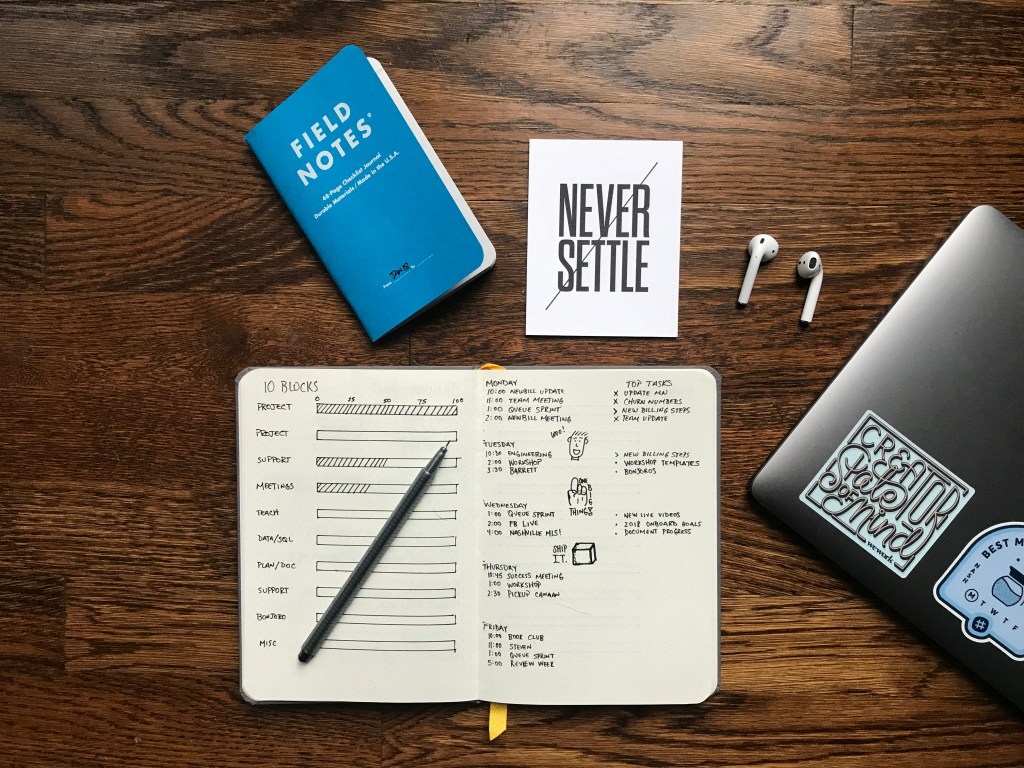
“The way we spend our days is, of course, the way we spend our lives.”
— Annie Dillard
I wasn’t always like this, you know.
I thought it was more efficient to just do the work that I had to do without organising everything into a task management tool. My primary question used to be “Why spend time writing something down in a different system when you could just do the work?”
I did not see any big impacts of not having an organisation system in place. Except, for when I grew in my career, had increased responsibilities. The first time I had a quarterly review of the impact of my work with my manager was a sight to behold.
Historically, I remembered my work well enough to coast my way through reviews. This time was different. I had not proofread my written self-evaluation. I rambled on, went on tangents, to be brought back by my manager, who was extremely considerate. Because I don’t think I would have been so patient at that time.
I came out of it with a feeling that I could have articulated the impact of my work better. As I attributed earlier, my manager was a very kind man. He extracted the right value out of my disoriented narrative.
However, a thought lingered in my mind, which wouldn’t go away until I made a change.
“There’s got to be a better way”
And there was. Enter organisation.
Organisation is a doctor to a chaotic mind
Every time you think of something you have to do, your brain tries to remember it, which exerts mental faculties that could be better spent actually doing something. The moment you offload the task on to an organisation system of your choice, you free your mind of it for the moment. You still pursue the ability to return to the task whenever you need to.
Organisation also allows us to reduce our mental load.
Now, I try to organise my work, which includes labelling, status management & deadlines. I have used a few systems in the past few years, all of which have yielded comparable effects. I can drive better accountability, my throughput has increased and my self-evaluations and narratives have become much, much more structured.
Why Organisation brings Meaning to Life?
Because I experienced benefits in the professional realm, I became intrigued with the potential applications of systemisation in my personal life.
The benefits translate exactly as I expected. After implementing an organisation system, I remember things better. I am more efficient with my writing as well.
After some introspection, I have come to realise that the principle behind this is a pretty well known phenomenon. Recently, I read a book by Napoleon Hill, focussing on the concept of “organised effort”.
Corporate companies have very well defined systems, which put people with coachable to high acumen into these system. Therefore, if the people were to just follow the letter of their laid-down law, the company still gets a positive outcome.
However, we hardly ever any structures, any organisation whatsoever, when it comes to our personal lives.
Consequently,
Most of what we do never matters.
We find it hard to recollect anything that we do. If pressured to pick what we remember, we recall the “big” events. Like weekends, holidays, birthdays & anniversaries. Over time, this becomes our default, and we live our lives around these events.
This way, we consistently have something to look forward to. But these events usually come only a few times a year. The rest of our years go by, pretty unmemorable.
Creating an organisation system increases the likelihood of memorable moments in our lives, beginning at a micro level..
If we have the “big” occasions of our days clearly mapped out, we have something to look forward to every day. Additionally, psychological studies have found a direct relationship between checking off tasks from our to-do lists to dopamine secretion events in our brains. Checking off a task from a to-do list equates to an accomplishment in our brains.
Micro-Achievements have a direct correlation to happiness.
Finally, because of the document trail we create, it is much easier for us to reflect and recall everything we have done in a day, a week, a month and even a year. Let’ say we document one big, memorable thing every day of the year. That makes for 365 memorable moments in a year.
A year worth remembering, but that happens every year.
Worth giving it a shot, wouldn’t you say? Let me know how it works out in the comments.




Leave a Reply