The world has become completely obsessed with optimisation, not for accuracy, but for comfort. Humans are problem solvers, and the problem we are solving with this optimisation is solving for comfort. But I feel we have taken it to a different extreme.
The moment we feel even a slightest bit of discomfort, the knee jerk response is to use aid, and make it go away.
The hidden question with this is “Why is this so hard? And why do I have to do it?”.
I get the whole “Spend more time sharpening your axe” argument, but what happened to the honest “roll up your sleeves and get to work” argument?
I have some beef with this thought process. Not because I don’t believe in optimisation, but I also believe in getting the job done.
If something is too hard right now, and there is no aid available, the flow chart has two branches, depending on the kind of person you are. Here’s my visualisation of the lifecycle of a task.
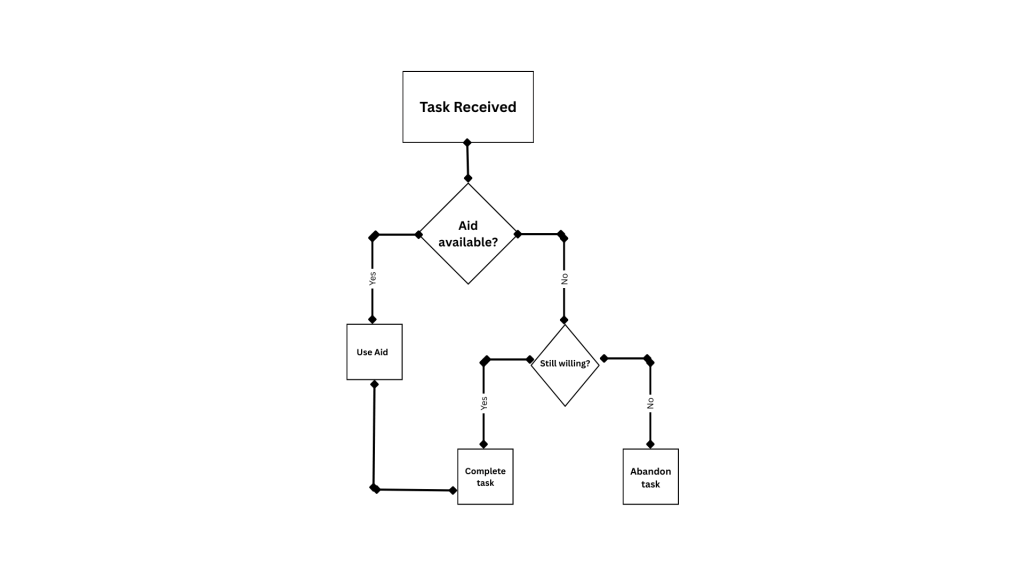
The graph that you see there is not designed for optimal engagement, and there are a few strong reason for that.
- To prove a point
- I am not a good designer.
The point is not that I am not a good designer. (For you sarcastic people out there).
The point is, I could very well have used AI (an aid) to create this. And I’m certain it would’ve done a much, much better job than I did at creating this.
However, while doing this, I realised there is a lot left for me to learn in this realm, something I wouldn’t have realised if I articulated what I wanted to AI to get an acceptable design.
There is something to be said about completing tasks and moving on. But this ever evolving desire for optimisation has increased the need for perfection.
As employees, the stakes are high and we ought to submit the best quality possible. But we reach that best quality by the trials and tribulations of learning and experience, and we reach there eventually.
But what about as regular people? The same desire for perfection more often than not kills the desire for us to pursue our hobbies and interests. Solely because we’re not going to be perfect the first time we try it. That feeling of lack prevents us from even taking the first step.
The TL;DR is
Get started, learn and repeat.
Even the people we may be looking up to at this time are not perfect. They’ve just reached our standard for what’s perfect.
We often forget that we play a key role in defining what perfect means, just like those who create things for us to evaluate.
Now about the second branch, of abandoning the task.
Well, what else are you going to do instead?
I believe this is a question everyone should ask themselves, consciously. Here, “consciously” is the keyword.
Unconsciously, you may think: “I don’t have the time to do anything apart from..” <Fill in your current “priorities”>
But are we being truly honest with ourselves when we say this?
I don’t want to give some long winded argument about this, because that would mean I am justifying my position for industry and action.
So, if you’re reading till here, I urge you to make that decision for yourself.
The TL;DR here is
We hear arguments all around, I can’t do this because of X or Y. But if X, Y and this are all hard, you ought to do something, because if not this, then what are we doing anyway?


Leave a Reply